AI-DM – AI-Powered Digital Marketing Platform - Gallery 1
AI-DM is an AI-powered digital marketing platform that helps businesses optimize their marketing campaigns and improve customer engagement.

AI-DM – AI-Powered Digital Marketing Platform - Gallery 2
AI-DM is an AI-powered digital marketing platform that helps businesses optimize their marketing campaigns and improve customer engagement.
Case Study: AI-DM - The Operating & Intelligence System for Marketing
Product: AI-DM (ai-dm.ai) - Decision-grade marketing infrastructure
Tagline: Marketing Intelligence, Governed.
Target Market: D2C Brands and Digital Marketing Agencies
Core Focus: Brand Intelligence, AI Content Generation, Multi-channel Unification
Key Technologies: Next.js, React, TypeScript, Tailwind CSS, Supabase
Pricing: ₹33,117 / ₹49,717 / ₹66,317 per month - Starter, Professional, Enterprise
ai-dm.ai - "Your marketing channels are producing data. But nothing is connecting the dots."
Executive Summary
AI-DM started from a pretty honest observation - most marketing teams have too much data and not enough clarity. You've got your SEO numbers in one tab, paid media in another, content metrics somewhere else, and none of it tells you whether your brand is actually getting stronger or quietly falling apart. That's the gap AI-DM was built to close.
It's a platform for D2C brands and agencies that want to stop reacting to fragmented reports and start governing their marketing from one place. There's a credit-based content engine, a brand configuration system that keeps every AI output on-brand, real-time job tracking, and three subscription tiers depending on how much volume you're running. We built it on Next.js with Supabase handling the backend.
The Problem: You Get the Data. You're Missing the Intelligence.
The issue isn't that brands don't have data - they have plenty of it. The issue is that none of it talks to each other. Your SEO tool doesn't know what your paid campaigns are doing. Your content team doesn't know what's actually converting. Your PR coverage doesn't feed back into your search authority. Everyone's optimising their own slice, and nobody's looking at the whole picture.
The SEO Blind Spot
Rankings look fine on paper - but are they built on real authority, or weak foundations that'll collapse the moment a competitor pushes harder?
The Paid Media Trap
ROAS looks healthy - but the moment you pause spend, demand dries up. You've been renting attention, not building it.
The PR Void
Coverage landed - but did it actually move the needle on brand authority, or just sit in a clippings folder and disappear?
The Content Noise Problem
Lots of content going out - but most of it isn't compounding. It's just volume for the sake of volume, and audiences have learned to scroll past it.
This is how strong brands quietly spiral. Budget keeps going to channels where the fundamentals are shaky. Problems only show up after momentum is already gone. AI-DM was built specifically to catch that before it happens.
The main dashboard after login - brand info, recent products, quick stats, and live job history all on one screen.
The Solution: Brand-Level Intelligence, Not More Data
Rather than building another reporting layer, we focused on making the platform actually useful at the execution level. There are three main parts to how it works.
1. The Brand Configuration System
Before anyone generates a single piece of content, they set up their brand properly. This isn't just a name and a logo - the platform asks for things like brand tone, brand story, vision, mission, and the industry and category the brand operates in. That information gets stored and referenced every time a content job runs.
The reason this matters is that most AI tools produce the same generic output regardless of who's using them. With AI-DM, a premium skincare brand and a B2B logistics company will get completely different content from the same job type, because the brand config is baked into every generation. Each field is editable independently, so as the brand evolves, the platform evolves with it.

The Brand Information page - tone, type, story, vision, and mission all configured here before any content generation happens.
2. The Content Generation Engine
Once the brand is set up, you get access to eight job modules. Each one is built for a specific type of output - no open-ended prompting, no guessing what to type. You fill in the parameters, hit create, and the platform handles the rest.
The Category SEO Article module is a good example of how the job system works. You pick a product, add subcategories you want the article to cover, set a word count target, drop in the main keyword, and choose which stage of the buyer journey you're targeting - from someone just researching all the way to someone ready to buy. There's also a Suggest button next to most fields that pulls recommendations based on the brand config, which saves a lot of time when you're running jobs across multiple clients.
Credits are consumed per job run. Starter gets 2,000 credits a month, Professional gets 5,000, and Enterprise gets 10,000. Unused credits roll over for up to three months, and you can top up any time without disrupting your account.
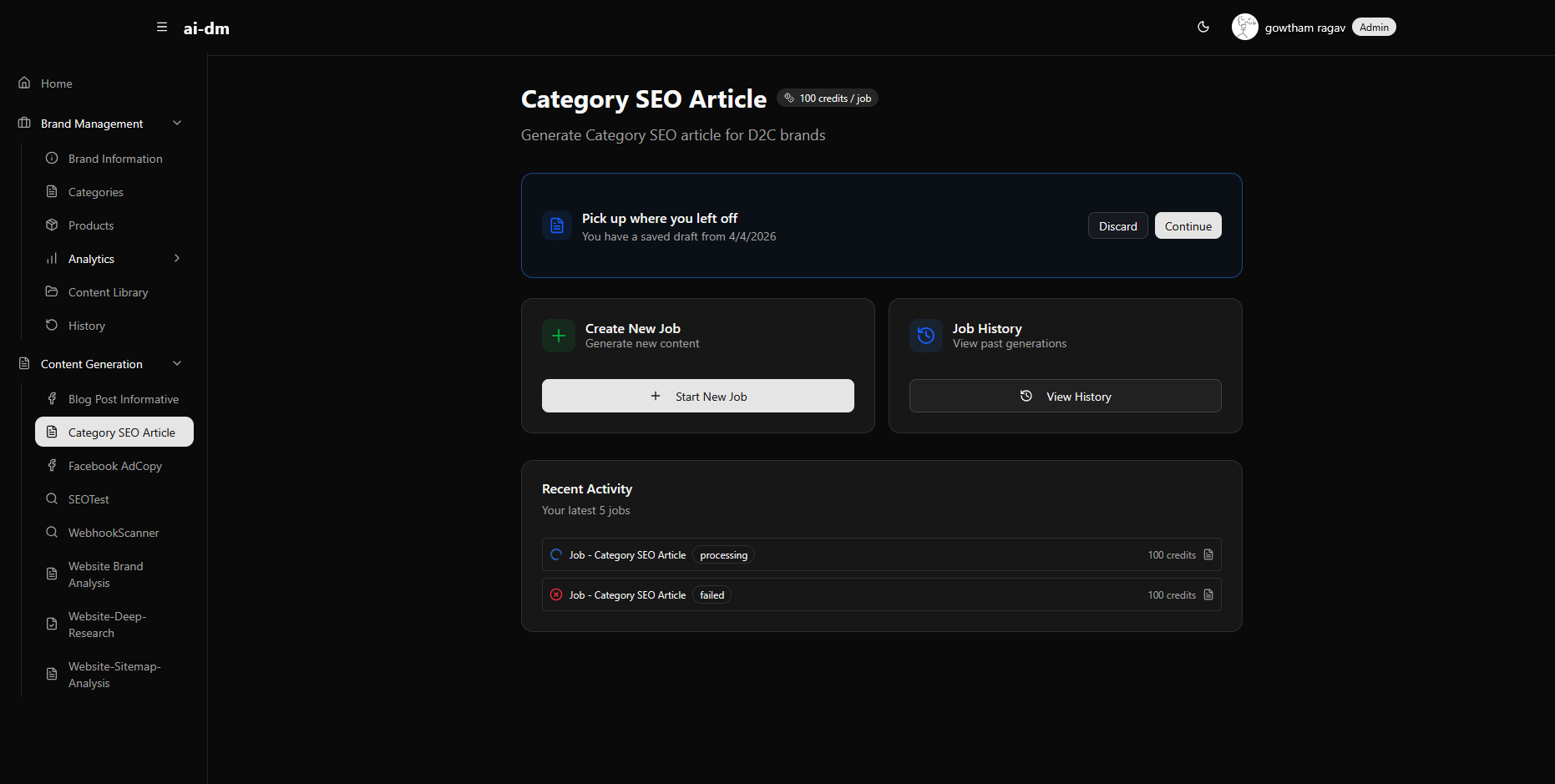
Creating a Category SEO Article - product, keyword, customer intent stage, and AI-suggested parameters all in one form.
3. Dashboard, Job History & Tracking
The home screen gives you a quick read on what's happening across your brand - how many products are set up, how many jobs have run, and how many completed successfully. The Recent Jobs panel on the right shows the last few generation runs with colour-coded statuses so you can see at a glance what's done and what needs attention.
The sidebar splits cleanly into two sections: Brand Management on top (Brand Information, Categories, Products, Analytics, Content Library, History) and Content Generation below (all eight job types). It's set up so you never have to dig around - everything you need is one click away regardless of what you were just doing.
Subscription Plans
The platform runs on a three-tier subscription model. All plans give you access to every module - the only difference is how many credits you get each month. There's a 14-day free trial on all plans, no card required, so teams can actually test it before committing.
Starter - ₹33,117/mo
2,000 credits per month. Good for smaller agencies or brands that are just getting their content operation off the ground. Billed annually at ₹3,31,170 - saves 17% vs monthly.
Professional - ₹49,717/mo
5,000 credits per month. The most popular tier for agencies managing a handful of active clients with a consistent publishing cadence. Billed annually at ₹4,97,170.
Enterprise - ₹66,317/mo
10,000 credits per month. For larger teams running high-volume content operations across many brands. Billed annually at ₹6,63,170.
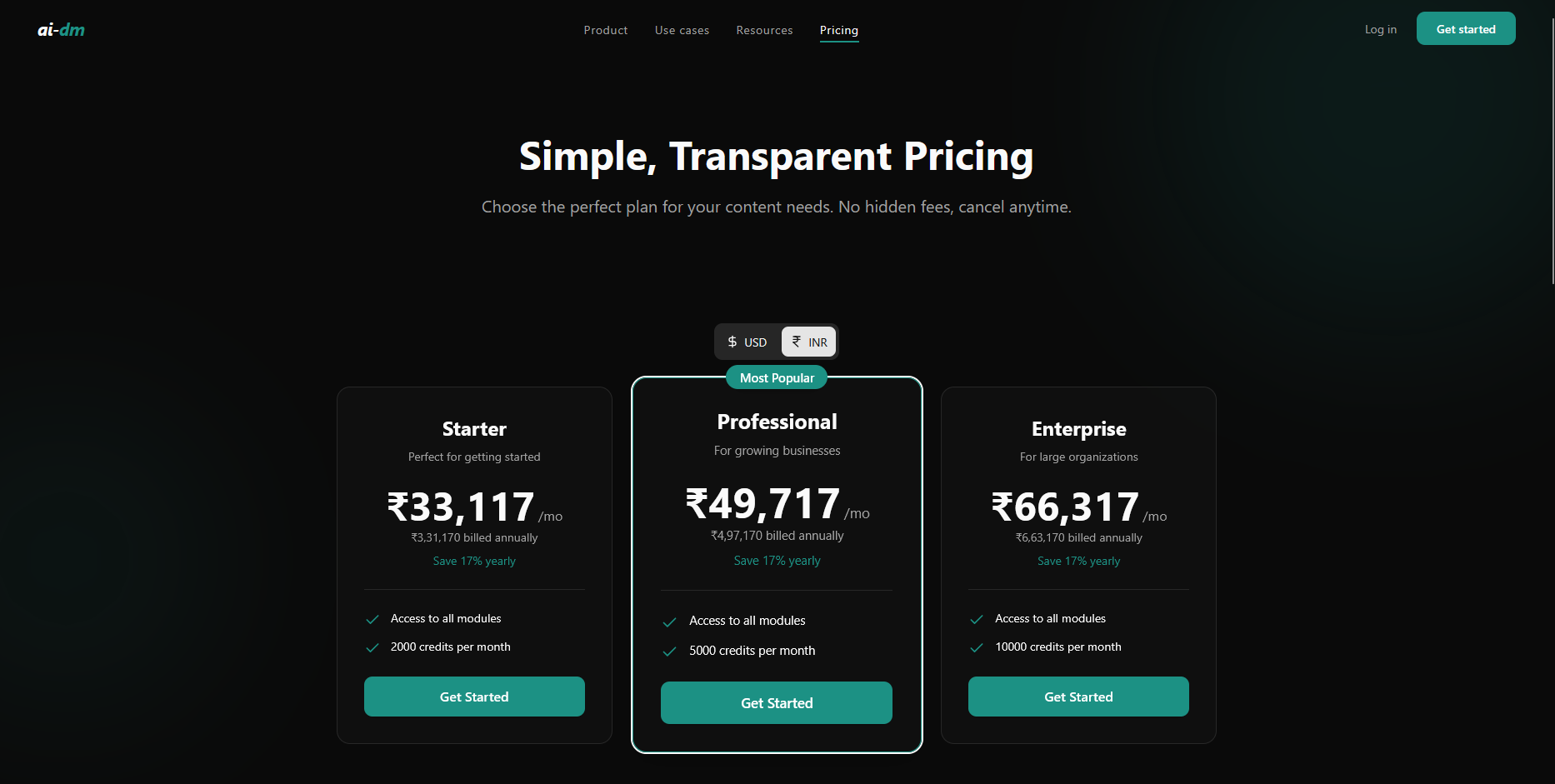
Pricing page - three tiers, all modules included, 17% savings on annual billing.
What We Delivered
One Place for Everything
SEO, content, paid, PR - all governed from a single platform instead of five different tools that don't talk to each other.
Content That Actually Sounds Like the Brand
The brand config system means every output is anchored to real brand parameters - not just a generic prompt with the company name dropped in.
A Real Content Workflow
Eight structured job modules replace the chaos of open-ended AI prompting with a repeatable process agencies can actually build around.
A Platform Ready to Sell
Three tiers, credit-based scaling, free trial, annual billing discounts - the commercial model is live and ready to onboard paying customers.
What We Learned Along the Way
1. The Brand Config Is What Makes It Different
Honestly, the content generation is almost secondary. Any decent AI can write a blog post. What makes AI-DM worth using is the brand configuration layer underneath it - the fact that tone, story, vision, and mission are all locked in before a single job runs. That's what separates it from being just another AI wrapper.
2. Structured Jobs Beat Open Prompts Every Time
We tested open-ended prompting early on and it just created friction. Users spent more time figuring out what to type than actually getting work done. Moving to structured job forms with defined input fields - and AI suggestions for those fields - made the whole thing faster and produced more consistent results.
3. Failed Jobs Need to Be Visible
If an AI generation fails and the user doesn't know about it, they lose trust in the platform fast. Making failed jobs clearly visible in the job history with a red status tag - rather than just silently dropping them - was a small change that made a big difference to how reliable the platform feels in day-to-day use.
4. Security Needs to Hold Without the UI
During testing we ran some API tampering attempts - trying to inject admin role payloads directly into backend endpoints, bypassing the frontend entirely. The platform blocked all of it at the route level with 403 responses. For a multi-tenant product where agencies are storing client brand data, that's the standard it needs to meet.
Conclusion
AI-DM is live and doing what it set out to do - giving agencies and D2C brands a way to govern their marketing instead of just reacting to it. The combination of a deep brand configuration system, structured content jobs, and a clean subscription model makes it something teams can actually build a workflow around, not just use once and forget.
If you're running marketing for a brand that's tired of having great data and no idea what it means, this is what we built it for.